
This article is taken from PN Review 288, Volume 52 Number 4, March - April 2026.
Pictures from the Rylands Library
Freud & Co in Manchester
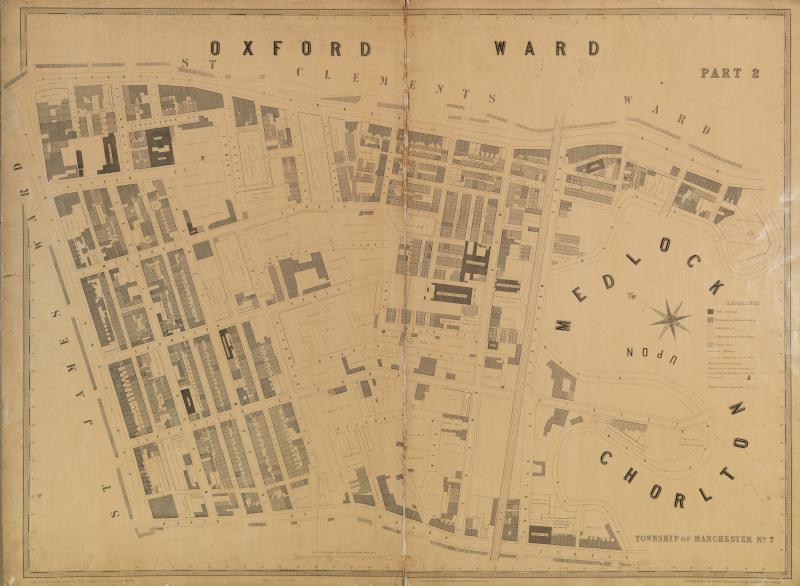
Bloom Street, Oxford Ward, Adshead’s Map of Manchester, 1850–1.
Image provided by and © of The John Rylands Research Institute and Library, The University of Manchester.
Published by Joseph Adshead between 1850 and 1851, this ‘cartographic gem’ was designed to reflect Manchester’s status as ‘the metropolis of manufacturing [with a] reputation for innovation and enterprise at the cutting edge of modernity’ (Brian Robson and Terry Wyke). It mapped the crammed geography of a town growing faster than any other at that time in Britain. Powered by an influx of immigrants, its population expanded to sate its industrial maw. Amongst them came two brothers, Emmanuel and Philipp, ‘precipitated by a catastrophe in the wool and textile market’ in Eastern Europe, where they, and their father Jacob, had ‘lost all their means’ (Rodger Willoughby).
They set up shop, initially in Lower Broughton, and sold small ornamental items, ‘buckles, ribbons, buttons, fans’ and other European imports. Establishing themselves as textile and fancy goods merchants, they ensured their family name of ‘Freud’ was noticed. It was however the achievements of their little half-brother Sigmund, then a mere child back in Austria, who, as the founder of psychoanalysis, was destined to put their name on the map.
The deep affection Freud had for his family in Manchester exerted a ‘decisive influence’ on him which lasted the length of his life. Growing up he cultivated an appetite for ‘all things English’ (Willoughby), even telling his friend H.G. Wells just before his death, ‘you cannot have known that since I first came to England as a boy, it became an intense wish phantasy of mine to… become an Englishman. Two of my half-brothers had done so 15 years before’. His notions of England, shaped during his visits, were largely formed through ‘talking, walking, eating and drinking’ with his brothers and their families in Manchester, with forays to Blackpool and St Annes (Willoughby).
Evidence of this longstanding bond survives within a cache of correspondence held within the Rylands offering an ‘insight into Freud’s emotional attachments to his extended family’ (Willoughby). Most of Freud’s letters are addressed to his nephew Sam at 61 Bloom Street (shown here on Adshead’s map) and date from the interwar years. They plot family concerns set against a backdrop of brutal historical realities. We are told of the deprivation the family suffered in the wake of the First World War and Sam’s efforts to alleviate these with regular parcels of food and aid. We feel the cold shadow of the Nazis’ rise to power and their persecution of the Jews. We are chilled when Freud tells Sam in 1933, ‘we are determined to stick it out here to the last. Perhaps it may not come out too bad.’ Then relieved by the final postcard (4 June 1938), which announces, ‘Leaving Vienna for good today’ and thankful to learn of Sam’s emotional reunion with Freud in London a few days later. As Freud prized his Manchester family so too did they honour him for, as Sam observed, ‘we think how proud Pa would have been to read in the papers all these references to Freudian theories. A newly coined adjective.’
This article is taken from PN Review 288, Volume 52 Number 4, March - April 2026.