

...probably the most informative and entertaining poetry journal in the English-speaking world.
John Ashbery
Since we started as Poetry Nation, a twice-yearly hardback, in 1973, we've been publishing new poetry, rediscoveries, commentary, literary essays, interviews and reviews from around the globe. In 2023 PN Review celebrated its jubilee.
Our vast archive now includes over 280 issues, with contributions from some of the most exciting and radical writers of our times. Key contributors include Octavio Paz, Laura Riding, Christopher Middleton, John Ashbery, Les Murray, Patricia Beer, W.S. Graham, Eavan Boland, Jorie Graham, Donald Davie, C.H. Sisson, Sinead Morrissey, Sasha Dugdale, Anthony Vahni Capildeo, and many others.
Our vast archive now includes over 280 issues, with contributions from some of the most exciting and radical writers of our times. Key contributors include Octavio Paz, Laura Riding, Christopher Middleton, John Ashbery, Les Murray, Patricia Beer, W.S. Graham, Eavan Boland, Jorie Graham, Donald Davie, C.H. Sisson, Sinead Morrissey, Sasha Dugdale, Anthony Vahni Capildeo, and many others.
Subscribe to PN Review
SUBSCRIBE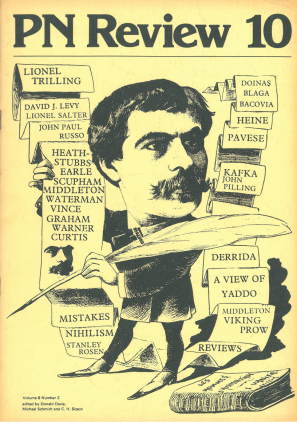 1979
1979
 1984
1984
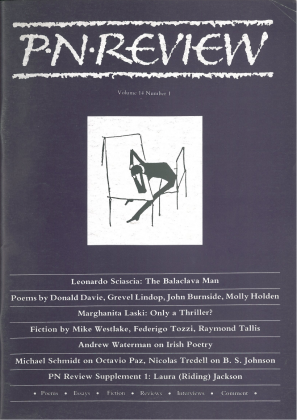 1987
1987
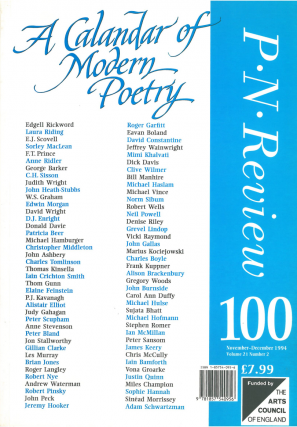 1994
1994
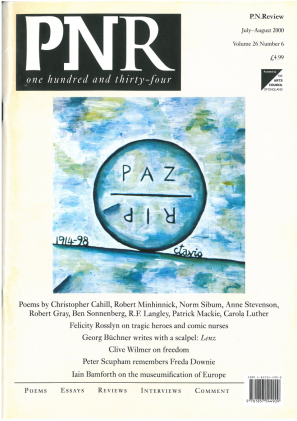 2000
2000
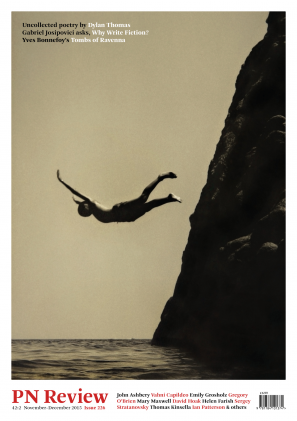 2015
2015
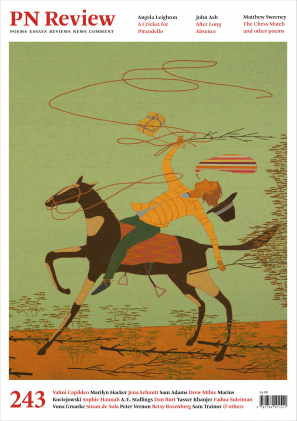 2018
2018
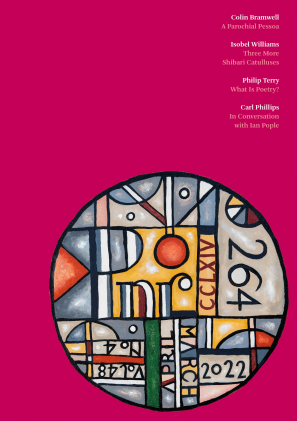 2022
2022
From the Archive
PoniesIt was just after the assassination of Indira Gandhi that I came into the employ of Jason Michael Stretch. Wellington is a city of hidden steps and narrow passages, dark tributary corridors which are rapidly being translated, courtesy of the new earthquake codings, into glittering malls and arcades, whole worlds of space-age glass and silver. Inside these places, on their several levels, there is a curious calm, which is now beginning to extend out on to the footpaths. No one points excitedly; people drift along, pale, ice-cold, gazing into windows in a way which is almost tranquil, or ride escalators which take them up and down but not quite anywhere. A few years ago - as, say, a first-year student - I think I might well have scorned these aimless citizens, or felt sorry for them: a bit superior, ... READ MORE
Readers' Choices
Rebecca Watts
(PN Review 239)
Stav Poleg
(PN Review 279)
Stav Poleg
(PN Review 276)
Stanley Moss
Rory Waterman
(PN Review 286)
(PN Review 239)
Stav Poleg
(PN Review 279)
Stav Poleg
(PN Review 276)
Stanley Moss
In conversation with Neilson MacKay
(PN Review 279)Rory Waterman
(PN Review 286)
Subscribe to our Substack to receive curated items from our archive.
SIGN UP