
This article is taken from PN Review 290, Volume 52 Number 6, July - August 2026.
Pictures from a Library
The Iliad and Some of Its Afterlives
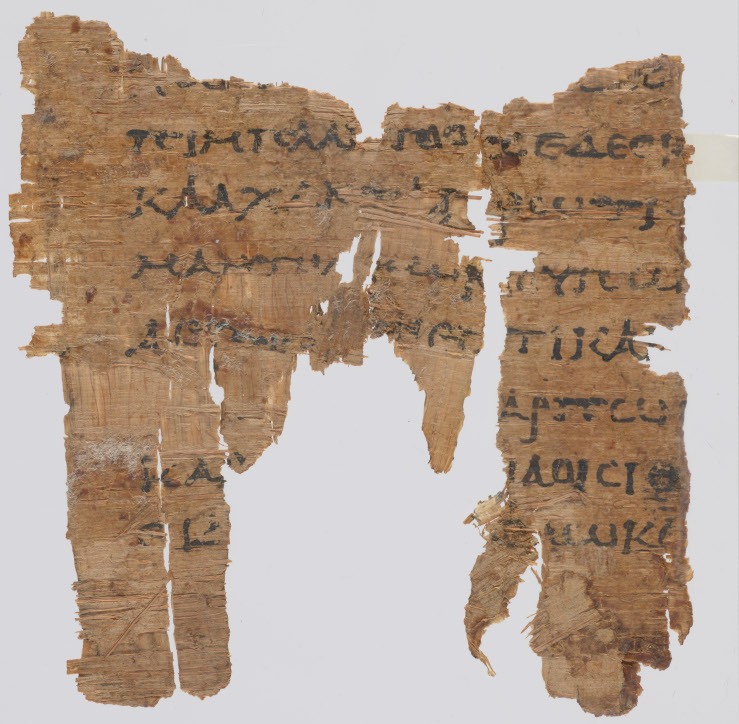
Fragment of Homer’s Iliad, 2nd Century BC. Image provided by and © of The John Rylands Research Institute and Library, The University of Manchester.
The Smithsonian Magazine recently reported that a team of Egyptian archaeologists had discovered a fragment of The Iliad during an excavation. Claimed to be the ‘first Greek literary text found in the context of mummification’ (Ellen Wexler), this account put me in mind of another literary papyrus held within the Rylands. Given that ‘knowledge once acquired must be repeated’ (Walter Ong), its story is worth retelling.
Before they were set down as written texts around 700–650 BC (Ong), the Iliad and Odyssey were, for centuries, transmitted from generation to generation as oral poems through mnemonic formulas which carried and preserved the most vital knowledge of the ancient Greek world. Stored in the collective memory of Greek oral culture, they were preserved in the performances of poets (Ong). Rendered into writing through the mechanism of the Greek alphabet and captured on the material surface of a page, the chirographic versions of these poems, by contrast, could be ‘kept, copied and repeated in unchangeable form theoretically forever’ (Eric Havelock), or so the logic goes. Yet their route to immortality was not always assured, for written texts can easily be mislaid, forgotten or destroyed. Sometimes, however, a lost text can resurface, as in the case of the fragment from the first book of the Iliad shown here.
Dating from the second century BC, this vestige of the poem was excavated from Egypt’s middens in 1917. Sight unseen, it was bought as part of a job lot of papyri by the Rylands in 1919 from J. Redel Harris for the considerable sum of £450. For years it languished unidentified within the library until 1936, as C.H. Roberts recounts, when it was eventually discovered buried in a piece of cartonnage, enclosed within an envelope and hidden in a miscellaneous bundle. Used to encase the mummified remains of human beings and sacred crocodiles, cartonnage is a type of funerary rag which consists of a complex stratigraphy.
Composed of glued together strips of papyrus and a covering of plaster, moulded and decorated with paint, it resists separation. In the 1930s the only way to excavate its textual components was by destroying the mummy casing in which they were contained, a practice contemporary papyrologists abjure (Roberta Mazza). In our case, the plaster layer was dissolved with acetic acid and the papyri immersed in boiling water for sixty seconds, ‘luckily no material damage resulted either to papyrus or ink’ (Roberts). What this ‘drastic procedure’ (Roberts) revealed was in fact six fragments of Book 1 of the Iliad collectively deemed to be of ‘considerable interest … with several unrecorded readings and two lines preserved of which there is no trace elsewhere’ (J. Johnson, V. Martin and A.S. Hunt).
So what was lost is found, as these erstwhile orts were restored to their status as texts through ‘the ultimate time machine of writing’ (Steven Fischer). By bringing them together in conversation with the newly discovered fragments in Egypt they come back to life to restore the poem’s voice.
This article is taken from PN Review 290, Volume 52 Number 6, July - August 2026.