
This article is taken from PN Review 289, Volume 52 Number 5, May - June 2026.
Pictures from a Library
Pictures from the Rylands Library
Seeking Sanctuary in an Early Printed Book
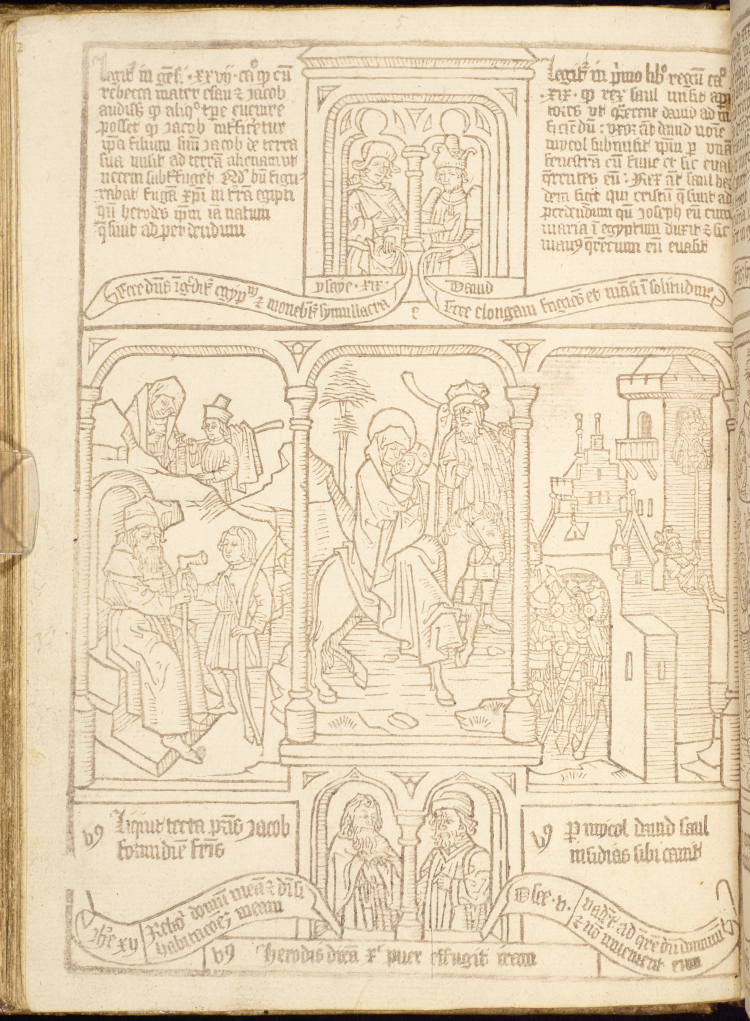
Biblia Pauperum, Netherlands, 1460s. (Image provided by and © of The John Rylands Research Institute and Library, The University of Manchester.)
According to the Encyclopaedia Britannica, the Chinese had by the sixth century CE invented printing. Having paper, a formula of ink known to them for many centuries, and woodblock surfaces bearing texts carved in relief at their disposal, they were able to produce the world’s oldest surviving printed books by 868 CE to be exact. Travelling along the Silk Road, perhaps aided by Mongol armies, printing reached many people across time and space before it arrived in the Europe of the later Middle Ages. The books printed in relief (known as xylographic or block books) are therefore perhaps better understood as the products of migrant technologies with venerable histories rather than just the ‘missing links’ in the story of the origins of European printing (Stephen Mossman and Edward Potten).
Dating from the 1460s, the block book shown here is known as a Biblia Pauperum. Though religious in its content it is ‘manifestly not a bible, nor was it for the poor’ (Avril Henry). It comprises forty full-page illustrations, with the layout of each leaf organised in a non-linear fashion and containing biblical images and Latin texts held within an architectural frame. Scenes from the life of Christ are placed centrally, flanked by events drawn from the Old Testament, and supported by prophetic texts that interlock to create a whole. This method of storytelling is typological, that is, ‘proleptic in intention’ (Marina Warner) as the ‘figuration of the future… [is foreshadowed] in the past’ (Tobin Nellhaus). Here within this book, an ‘externalised, physical form of memory’ (Nellhaus), the prophesies of the Old Testament are shown to be fulfilled within the New. Speaking ‘in chords [that resonate] across time… where different time zones are compressed, [it brings] the past to fold into the present’ (Warner), thereby implicating not only the readers of the past but also those in the here, now and even future too.
Take for example the page shown here. On the left, Jacob prepares to flee from his murderous brother Esau, while on the right King David is winched down a tower to avoid destruction by Saul’s army. These scenes represent prophesies from the Old Testament which are inscribed on scrolls in ‘barely legible Latin’ (Henry) unfurled by prophets at the head and foot of the page. That Christ has achieved their accomplishment is shown in its centre, through the figure of the Holy Family’s flight into Egypt, ‘I have abandoned my house and left my home’ (Jeremiah xii:7). So we are confronted by the all too contemporary story of the plight of the fugitive in the act of escaping danger only to be unhomed and exposed to the sorrow of exile, for ‘no return journey tomorrow can reach a place of yesterday’ (Ece Temelkuran). It therefore seems that although the pages of the Biblia Pauperum were designed as a ‘prelude to prayer’ (Henry) for its medieval readers, they can still prick our consciences today and speak of the ‘state of forced exiles at any time’ (Warner).
Seeking Sanctuary in an Early Printed Book
Biblia Pauperum, Netherlands, 1460s. (Image provided by and © of The John Rylands Research Institute and Library, The University of Manchester.)
According to the Encyclopaedia Britannica, the Chinese had by the sixth century CE invented printing. Having paper, a formula of ink known to them for many centuries, and woodblock surfaces bearing texts carved in relief at their disposal, they were able to produce the world’s oldest surviving printed books by 868 CE to be exact. Travelling along the Silk Road, perhaps aided by Mongol armies, printing reached many people across time and space before it arrived in the Europe of the later Middle Ages. The books printed in relief (known as xylographic or block books) are therefore perhaps better understood as the products of migrant technologies with venerable histories rather than just the ‘missing links’ in the story of the origins of European printing (Stephen Mossman and Edward Potten).
Dating from the 1460s, the block book shown here is known as a Biblia Pauperum. Though religious in its content it is ‘manifestly not a bible, nor was it for the poor’ (Avril Henry). It comprises forty full-page illustrations, with the layout of each leaf organised in a non-linear fashion and containing biblical images and Latin texts held within an architectural frame. Scenes from the life of Christ are placed centrally, flanked by events drawn from the Old Testament, and supported by prophetic texts that interlock to create a whole. This method of storytelling is typological, that is, ‘proleptic in intention’ (Marina Warner) as the ‘figuration of the future… [is foreshadowed] in the past’ (Tobin Nellhaus). Here within this book, an ‘externalised, physical form of memory’ (Nellhaus), the prophesies of the Old Testament are shown to be fulfilled within the New. Speaking ‘in chords [that resonate] across time… where different time zones are compressed, [it brings] the past to fold into the present’ (Warner), thereby implicating not only the readers of the past but also those in the here, now and even future too.
Take for example the page shown here. On the left, Jacob prepares to flee from his murderous brother Esau, while on the right King David is winched down a tower to avoid destruction by Saul’s army. These scenes represent prophesies from the Old Testament which are inscribed on scrolls in ‘barely legible Latin’ (Henry) unfurled by prophets at the head and foot of the page. That Christ has achieved their accomplishment is shown in its centre, through the figure of the Holy Family’s flight into Egypt, ‘I have abandoned my house and left my home’ (Jeremiah xii:7). So we are confronted by the all too contemporary story of the plight of the fugitive in the act of escaping danger only to be unhomed and exposed to the sorrow of exile, for ‘no return journey tomorrow can reach a place of yesterday’ (Ece Temelkuran). It therefore seems that although the pages of the Biblia Pauperum were designed as a ‘prelude to prayer’ (Henry) for its medieval readers, they can still prick our consciences today and speak of the ‘state of forced exiles at any time’ (Warner).
This article is taken from PN Review 289, Volume 52 Number 5, May - June 2026.