
This item is taken from PN Review 289, Volume 52 Number 5, May - June 2026.
Letters to the Editor
Peter Jones
Michael Freeman writes: I was moved to read in the PNR 288 editorial that Peter Jones has died. I knew so little about Peter even though he and I worked with each other in those Carcanet and PN Review Corn Exchange years. Well, rather, worked alongside each other, comfortably but as on separate orbits, so different were we in our pasts and our preoccupations. We puzzled each other, albeit cheerfully enough. Perhaps the one facet your editorial tribute underplayed was his sheer commitment to the grinding, necessary tasks: all those years at the mill, typesetting and imaginative accounting, keeping the show on the road, this besides the multi-faceted creativity that your editorial touches on.
Life in prose
Robyn Marsack writes: I was intrigued by the ‘poetic hypothesis’ proposed by Brendan Bedard and Andie Kristina concerning the death of Louis MacNeice, and found it persuasive (PNR 288). Still, I was surprised that they thought he had not had time to reflect on his life in prose: The Strings Are False, published posthumously in 1966, is certainly incomplete but covers the years up to 1941. Jon Stallworthy’s biography, Louis MacNeice (1995), provides sympathetic coverage of the whole life. The authors’ remark that MacNeice remains ‘a promising but incomplete figure’ is also a surprising verdict on the author of Autumn Journal and The Burning Perch, for example, two indisputably brilliant achievements.
Seated statuary
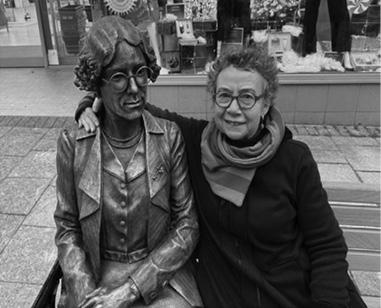
John Wilkinson writes: The small county town of Dorchester boasts a distinguished literary history. It has been proud to commemorate in statues Thomas Hardy and the great philologist and dialect poet William Barnes. The town’s hospitality in statuary has now extended to the queer communist novelist, poet and musicologist Sylvia Townsend Warner. Thanks to a crowdfunder organised by Visible Women UK, a statue of Warner by Denise Dutton was unveiled in December before a large and enthusiastic crowd in the town’s shopping centre. The statue’s ground-level seated composition contrasts strikingly with the magisterial presentations of Hardy and Barnes, and while reminiscent of the statue of Pessoa in Lisbon, Warner’s seating on a bench rather than a chair invites companionship from passers-by. Notable at the unveiling was the banner of the XV Brigada Internacional held aloft by a representative of the International Brigade Memorial Trust – in recognition of Warner’s support of the Spanish Republic, including work at the hospital in Granen alongside her partner Valentine Ackland. In the photograph Maud Ellmann joins Warner on her seat.
The year 2026 will see the publishing centenary of Warner’s first novel, Lolly Willowes. A celebratory conference marks the occasion at University College London on 29 and 30 May 2026 under the auspices of The Sylvia Townsend Warner Society. Adam Mars-Jones, Diane Purkiss, Ronald Hutton and Philip Hensher are among the speakers.
Michael Freeman writes: I was moved to read in the PNR 288 editorial that Peter Jones has died. I knew so little about Peter even though he and I worked with each other in those Carcanet and PN Review Corn Exchange years. Well, rather, worked alongside each other, comfortably but as on separate orbits, so different were we in our pasts and our preoccupations. We puzzled each other, albeit cheerfully enough. Perhaps the one facet your editorial tribute underplayed was his sheer commitment to the grinding, necessary tasks: all those years at the mill, typesetting and imaginative accounting, keeping the show on the road, this besides the multi-faceted creativity that your editorial touches on.
Life in prose
Robyn Marsack writes: I was intrigued by the ‘poetic hypothesis’ proposed by Brendan Bedard and Andie Kristina concerning the death of Louis MacNeice, and found it persuasive (PNR 288). Still, I was surprised that they thought he had not had time to reflect on his life in prose: The Strings Are False, published posthumously in 1966, is certainly incomplete but covers the years up to 1941. Jon Stallworthy’s biography, Louis MacNeice (1995), provides sympathetic coverage of the whole life. The authors’ remark that MacNeice remains ‘a promising but incomplete figure’ is also a surprising verdict on the author of Autumn Journal and The Burning Perch, for example, two indisputably brilliant achievements.
Seated statuary
John Wilkinson writes: The small county town of Dorchester boasts a distinguished literary history. It has been proud to commemorate in statues Thomas Hardy and the great philologist and dialect poet William Barnes. The town’s hospitality in statuary has now extended to the queer communist novelist, poet and musicologist Sylvia Townsend Warner. Thanks to a crowdfunder organised by Visible Women UK, a statue of Warner by Denise Dutton was unveiled in December before a large and enthusiastic crowd in the town’s shopping centre. The statue’s ground-level seated composition contrasts strikingly with the magisterial presentations of Hardy and Barnes, and while reminiscent of the statue of Pessoa in Lisbon, Warner’s seating on a bench rather than a chair invites companionship from passers-by. Notable at the unveiling was the banner of the XV Brigada Internacional held aloft by a representative of the International Brigade Memorial Trust – in recognition of Warner’s support of the Spanish Republic, including work at the hospital in Granen alongside her partner Valentine Ackland. In the photograph Maud Ellmann joins Warner on her seat.
The year 2026 will see the publishing centenary of Warner’s first novel, Lolly Willowes. A celebratory conference marks the occasion at University College London on 29 and 30 May 2026 under the auspices of The Sylvia Townsend Warner Society. Adam Mars-Jones, Diane Purkiss, Ronald Hutton and Philip Hensher are among the speakers.
This item is taken from PN Review 289, Volume 52 Number 5, May - June 2026.